The honest starting point for anyone researching the best medical schools in the US is that the famous ranked list barely exists anymore. Beginning in 2023, most of the top medical schools withdrew from the US News rankings, and US News responded by scrapping numbered ranks entirely in favour of broad tiers. A rigid “top 50, ranked one to fifty” list is now out of date the moment it is published. That is not bad news. It frees you to choose a school the way admissions deans actually recommend: by fit, cost, and outcomes. Below is the real picture, including the schools still consistently regarded as top-tier, the one objective ranking that still holds up, detailed profiles of the leading schools, and how to choose well.
What Happened to the Rankings
In January 2023, Harvard Medical School, then ranked number one for research, announced it would no longer participate in the US News Best Medical Schools rankings. Within weeks, Columbia, Stanford, Penn, Mount Sinai, Cornell, Duke, Chicago, Washington University in St. Louis, and the University of Michigan followed, and Johns Hopkins withdrew that May after roughly three decades of participating.
Their stated reasons were consistent. The deans argued that the rankings rewarded wealth and selectivity, pushed schools to chase high test scores over qualities like resilience and empathy, and created pressure to divert financial aid toward high-scoring applicants rather than students with genuine need.
Two schools often wrongly listed among the withdrawals did not leave: Mayo Clinic Alix continued to participate, and Vanderbilt’s much-discussed boycott was its law school, not its medical school.
What US News Publishes Now
US News no longer assigns numbered ranks to medical schools. Since 2024 it has grouped schools into four tiers, listed alphabetically within each tier, across two separate lists for Research and for Primary Care. The most recent edition, released in 2026, is the third consecutive tier-based year.
The practical meaning: the list now covers only schools that chose to participate, omits many of the most prestigious programmes, and shows a tier rather than a precise position. Anyone presenting a confident numbered ranking of the “50 best” is working from a framework that no longer exists.
The One Ranking That Still Holds Up: NIH Funding
If you want an objective measure, this is it. The Blue Ridge Institute publishes an annual ranking of medical schools by National Institutes of Health research funding, based on actual federal grant dollars rather than surveys or reputation. It cannot be gamed the way a survey can. Here are the top 20 schools of medicine by NIH funding for the 2024 fiscal year.
| # | School | FY2024 NIH funding |
|---|---|---|
| 1 | UC San Francisco | $726 million |
| 2 | Washington University in St. Louis | $683 million |
| 3 | Yale | $598 million |
| 4 | Penn (Perelman) | $588 million |
| 5 | Vanderbilt | $586 million |
| 6 | Johns Hopkins | $572 million |
| 7 | Stanford | $549 million |
| 8 | Pittsburgh | $535 million |
| 9 | Columbia (Vagelos) | $527 million |
| 10 | Michigan | $510 million |
| 11 | NYU (Grossman) | $490 million |
| 12 | Icahn (Mount Sinai) | $460 million |
| 13 | Duke | $455 million |
| 14 | UC San Diego | $422 million |
| 15 | Northwestern (Feinberg) | $414 million |
| 16 | UCLA (Geffen) | $404 million |
| 17 | University of Washington | $381 million |
| 18 | Emory | $375 million |
| 19 | UNC Chapel Hill | $349 million |
| 20 | Baylor | $320 million |
One technical note, because it is widely misreported: this is the schools-of-medicine ranking. A university-wide ranking looks different, which is why Johns Hopkins leads university-wide but sits sixth among schools of medicine.
The Leading Research Schools, Profiled
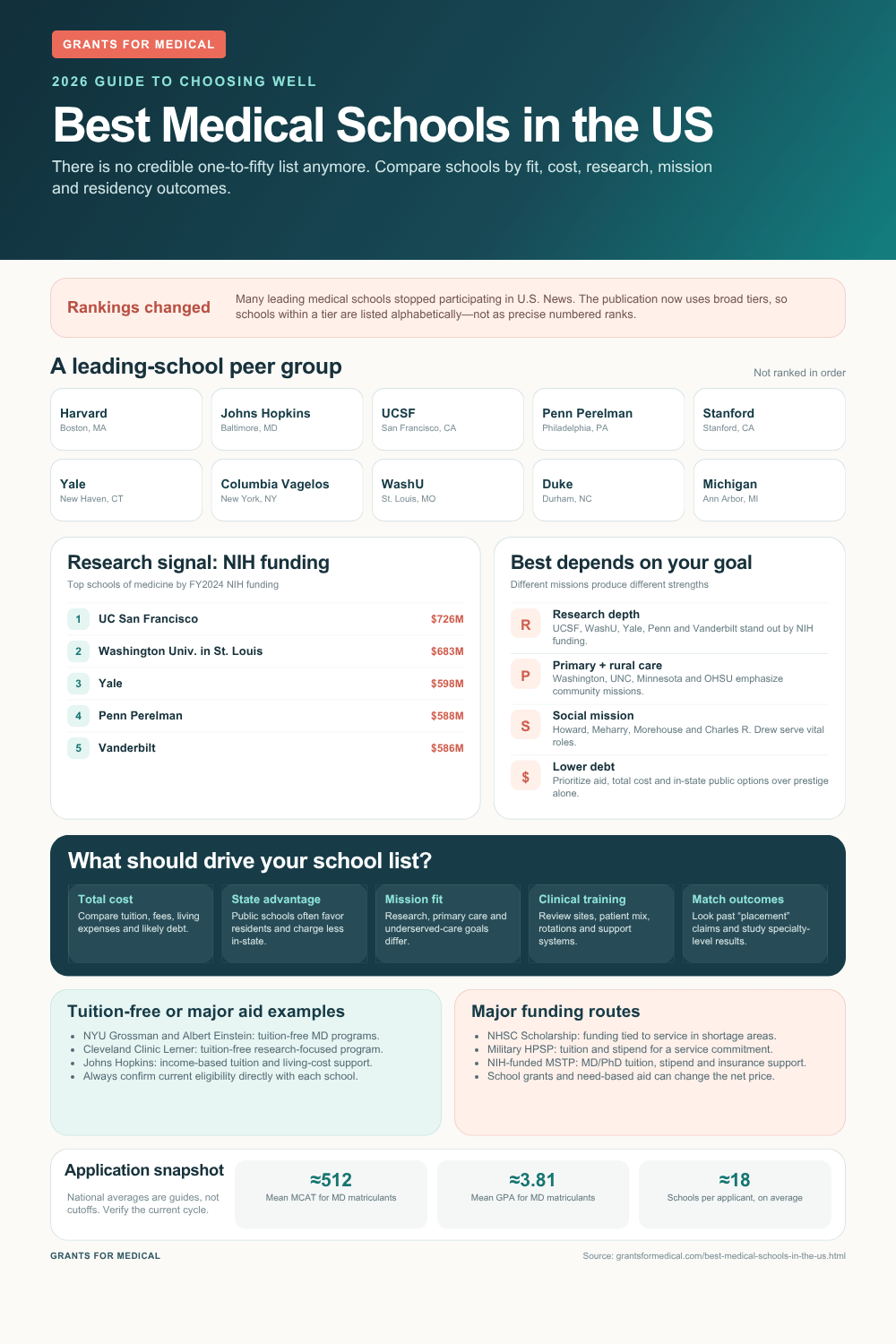
Here are the schools that consistently sit at the top across funding, reputation, and selectivity. Treat these as a peer group rather than a strict order.
UC San Francisco (public, San Francisco). The number one NIH-funded medical school in the country and the only University of California campus devoted entirely to health sciences, with no undergraduates. Unusually strong in both research and primary care through its PRIME programmes.
Harvard (private, Boston). Its Pathways curriculum and the joint Harvard-MIT Health Sciences and Technology track for physician-scientists anchor the largest teaching-hospital network in the country. Much of its NIH money flows through affiliated hospitals like Massachusetts General rather than the school directly.
Johns Hopkins (private, Baltimore). The model on which the American research medical school was built, with its “Genes to Society” curriculum. Since 2024 it offers free tuition for families under $300,000, and free tuition plus living costs under $175,000.
Penn, Perelman (private, Philadelphia). The oldest medical school in the US, founded in 1765, and the birthplace of CAR-T cell therapy and the foundational mRNA vaccine work that won a 2023 Nobel Prize.
Washington University in St. Louis (private). The second most NIH-funded school and a genomics powerhouse central to the Human Genome Project, with a $100 million scholarship programme that lets up to half of students attend tuition-free.
Stanford (private, California). Its Discovery Curriculum requires a scholarly concentration, and its Silicon Valley setting drives deep biotech and biodesign ties.
Yale (private, New Haven). The distinctive “Yale System” uses no internal grades or class rank in the preclinical years and requires an MD thesis, built around self-directed learning.
Columbia, Vagelos (private, New York). A $250 million gift replaced loans with scholarships for all aid-qualifying students. It descends from the first US institution to grant the MD degree.
Vanderbilt (private, Nashville). Its competency-based “Curriculum 2.0” and fifth-place NIH funding show a school punching well above its size.
Duke (private, Durham). Compresses the preclinical sciences to free the entire third year for independent research, a structure unique among top schools.
Michigan (public, Ann Arbor). One of the oldest public medical schools, with a competency-based “Victors” curriculum and top-ten NIH funding.
NYU Grossman (private, New York). Tuition-free for all MD students since 2018, regardless of need or merit, and home to an accelerated three-year MD pathway.
Mayo Clinic Alix (private, Rochester with Arizona and Florida campuses). Free tuition for all incoming MD students since 2019, small cohorts, and a three-state campus integrated with the Mayo Clinic.
Weill Cornell (private, New York). Part of a Manhattan tri-institutional research hub with Rockefeller and Memorial Sloan Kettering, with debt-free need-based aid.
Icahn at Mount Sinai (private, New York). Its scholarship initiative caps student debt, and its FlexMed programme offers early assurance to non-science majors.
Northwestern Feinberg (private, Chicago). A downtown campus tied to Northwestern Memorial and Lurie Children’s, with a very high scholarship rate.
Pittsburgh (public). Partnered with the UPMC health system, with historic strength in organ transplantation.
UCLA Geffen (public, Los Angeles). Offers full-ride Geffen Medical Scholarships and runs a PRIME programme focused on underserved care.
UC San Diego (public). Known for its integrated curriculum and a strong translational research base.
Emory (private, Atlanta). Close ties to the CDC, Grady Memorial safety-net hospital, and a national primate research centre give it real strength in vaccines and infectious disease.
Baylor (private, Houston). Sits in the world’s largest medical complex and charges the lowest tuition of any elite private school, at roughly half the usual figure.
Others consistently well-regarded include the University of Chicago Pritzker, Case Western Reserve, UT Southwestern with its notably low in-state tuition and six affiliated Nobel laureates, the University of Colorado Anschutz with the top-funded paediatrics programme in the country, the University of Virginia, Brown, Boston University, and Georgetown.
Primary Care and Mission-Focused Schools
A research powerhouse is not the right choice for everyone. If you want primary care, rural medicine, or work with underserved communities, these schools are leaders.
University of Washington runs the WWAMI programme spanning Washington, Wyoming, Alaska, Montana, and Idaho, and consistently ranks at the top nationally for primary care and rural medicine. UNC Chapel Hill combines strong research funding with a heavy in-state, underserved-community mission. University of Minnesota, particularly its Duluth campus, trains physicians for rural and Native American communities. Oregon Health and Science University, Oregon’s only medical school, has an explicit serve-the-state mission with about 70% in-state students.
The Historically Black Medical Schools
Four institutions deserve specific mention, because together they have educated a large share of the country’s Black physicians, a vital role given that Black doctors make up about 5% of the profession against 13% of the population.
Howard University College of Medicine (Washington, D.C.) opened in 1868, three years after the Civil War, and with Meharry is credited with training the majority of Black US physicians for much of the twentieth century.
Meharry Medical College (Nashville), founded in 1876, is one of the oldest and largest historically Black academic health science centres.
Morehouse School of Medicine (Atlanta), founded in 1975, was the first medical school established at a historically Black college in the twentieth century and ranks nationally at the top for social mission and primary-care production.
Charles R. Drew University (Los Angeles), founded in 1966 after the Watts uprising, is the only historically Black medical institution west of Texas, named for the blood-banking pioneer Dr. Charles R. Drew.
MD Versus DO
A point of frequent confusion. Both MD and DO graduates are fully licensed physicians with identical practice rights in all 50 states. DO training adds osteopathic manipulative medicine and a whole-person philosophy.
Osteopathic medicine is growing fast, now representing around 30% of all US medical students. Since a single accreditation system was completed in 2020, MD and DO graduates train in the same residency programmes, which has largely erased the old practical distinction. There are 156 or so accredited MD schools and 48 osteopathic colleges in the US.
The Tuition-Free Movement
Since student debt shapes careers so heavily, the wave of tuition-free and heavily subsidised schools is one of the most important developments in medical education.
| School | What it offers |
|---|---|
| NYU Grossman | Free tuition for all MD students since 2018 |
| Albert Einstein | Tuition-free in perpetuity since 2024, after a $1 billion gift |
| Johns Hopkins | Free for families under $300,000 since 2024 |
| Cleveland Clinic Lerner | Tuition-free since 2008, the first such US school |
| Mayo Clinic Alix | Free tuition for all incoming students since 2019 |
| Kaiser Permanente | Free tuition for early cohorts through the class entering 2026 |
| Columbia, WashU | Loans replaced with scholarships for students with need |
Note that some of these, like Kaiser Permanente’s waiver, are time-limited, so always confirm current terms directly with the school.
What Actually Matters When Choosing
The AAMC, the body representing medical schools, literally titles its own guidance “Ignore the National Rankings and Make Your Own School List.” Here is what to weigh instead.
Cost and debt. Median education debt among indebted graduates is around $205,000, and roughly two-thirds of graduates carry debt. A four-year total cost of attendance runs to a median near $286,000 at public schools and $391,000 at private ones. Heavy debt pushes graduates toward higher-paying specialties, so this shapes your future more than prestige does.
The in-state public advantage. In-state tuition at a public school is dramatically lower than out-of-state or private tuition, and public schools prioritise in-state applicants. For most people this matters more than any ranking.
Mission and curriculum fit. A research school and a primary-care school suit different people. Match the school to what you actually want to do.
Match rates, read carefully. In 2026, about 93.5% of US MD seniors and 93.2% of DO seniors matched into residency. Be wary of a school advertising “100% placement,” which can fold in the post-match scramble and later cycles. Ask for the match rate specifically.
Just getting in. The hardest part is acceptance anywhere. Only about 44% of applicants are accepted to any medical school in a given cycle, and per-school acceptance rates are often around 4%, which is why applicants average roughly 18 applications.
The Numbers You Need to Apply
Average matriculant statistics give a realistic target. For MD schools, a mean MCAT around 512 and GPA around 3.81. For DO schools, a mean MCAT around 503 and GPA around 3.59. The most selective schools profiled above cluster considerably higher, with median MCAT scores around 520 and GPAs near 3.9.
Applications go through AMCAS for MD schools and AACOMAS for DO schools. Between fees, the MCAT, secondary applications, and travel, a realistic application cycle costs $5,000 to $10,000 or more.
One structural change worth knowing: the USMLE Step 1 licensing exam became pass/fail in 2022, which shifted weight onto Step 2, clinical performance, and school reputation.
Paying for It
Beyond the tuition-free schools above, the main funding routes are worth knowing.
The NHSC Scholarship covers tuition, fees, and a stipend in exchange for a two-to-four-year service commitment in a shortage area, aimed at primary care. Military HPSP covers full tuition plus a monthly stipend in exchange for active-duty service. MD/PhD programmes funded through the NIH Medical Scientist Training Program provide full tuition, a stipend, and health insurance for students pursuing research careers.
Best Medical Schools FAQs
What are the best medical schools in the US?
The schools consistently regarded as top-tier include Harvard, Johns Hopkins, Penn, Stanford, UC San Francisco, Columbia, Mayo, Washington University, Duke, Yale, and Michigan. There is no longer a reliable numbered ranking, since most top schools withdrew from US News, which now uses tiers.
Which medical school gets the most research funding?
By NIH funding, the most objective measure, UC San Francisco led in the 2024 fiscal year at $726 million, followed by Washington University in St. Louis, Yale, Penn, and Vanderbilt.
Why did medical schools leave the US News rankings?
Starting in 2023, Harvard and most other top schools withdrew, arguing the rankings rewarded wealth and test scores over qualities like empathy and discouraged need-based aid. US News now publishes tiers rather than numbered ranks.
Which medical schools are tuition-free?
NYU Grossman, Albert Einstein, Cleveland Clinic Lerner, and Mayo Clinic Alix offer free tuition to all MD students. Johns Hopkins is free for families under $300,000, and Columbia and Washington University replace loans with scholarships for students with need.
Is a DO as good as an MD?
Both are fully licensed physicians with identical practice rights, and since 2020 they train in the same residency programmes. DO training adds osteopathic manipulative medicine, and osteopathic students are now about 30% of all US medical students.
How hard is it to get into medical school?
Very. Only about 44% of applicants are accepted anywhere in a cycle, per-school rates are often around 4%, and applicants average about 18 applications. Average matriculants have an MCAT around 512 and GPA around 3.81 for MD schools.
Explore Medical Schools & Rankings
Compare specific programs and see where schools rank:
- Duke
- Dell (UT Austin)
- Emory
- Yale
- NYU acceptance rate
- Eastern Virginia
- How to get into Harvard
- Best in California
- Best dermatology schools
- Best dental schools in California
- Best nursing schools in Georgia
- Easiest to get into
- How many in the U.S.
Getting Into Medical School
What it takes to apply and get accepted:
- AAMC application process
- Interview questions
- Personal statement
- Letter of intent
- Update letter
- Volunteer hours
- Clinical experience
- How hard is it
- How long is it
- Curriculum
- Becoming a neurosurgeon
Paying for Medical School
Costs, loans, and grants that help cover tuition:
- How much it costs
- Best medical school loans
- Paying without loans
- Government grants
- Grants for minorities
- Grants for dental school
- Grants for cosmetology school
Program availability, eligibility rules, deadlines, and award amounts can change, and submitting an application does not guarantee funding.