Hearing aids are one of the few pieces of medical equipment most people buy entirely with their own money. Original Medicare does not pay for them, most state Medicaid programs do not pay for them for adults, and the sticker price at a traditional clinic still runs close to five thousand dollars a pair. That gap is why so many people search for a cheap hearing aid and end up either overpaying or buying something that sits in a drawer.
This guide covers what hearing aids actually cost in 2026, where the real savings are, what the over the counter category changed, and which programs help people who cannot pay. Prices below come from a 2026 survey of 879 US buyers, so treat them as what people report paying, not as a quote.
What hearing aids cost in 2026
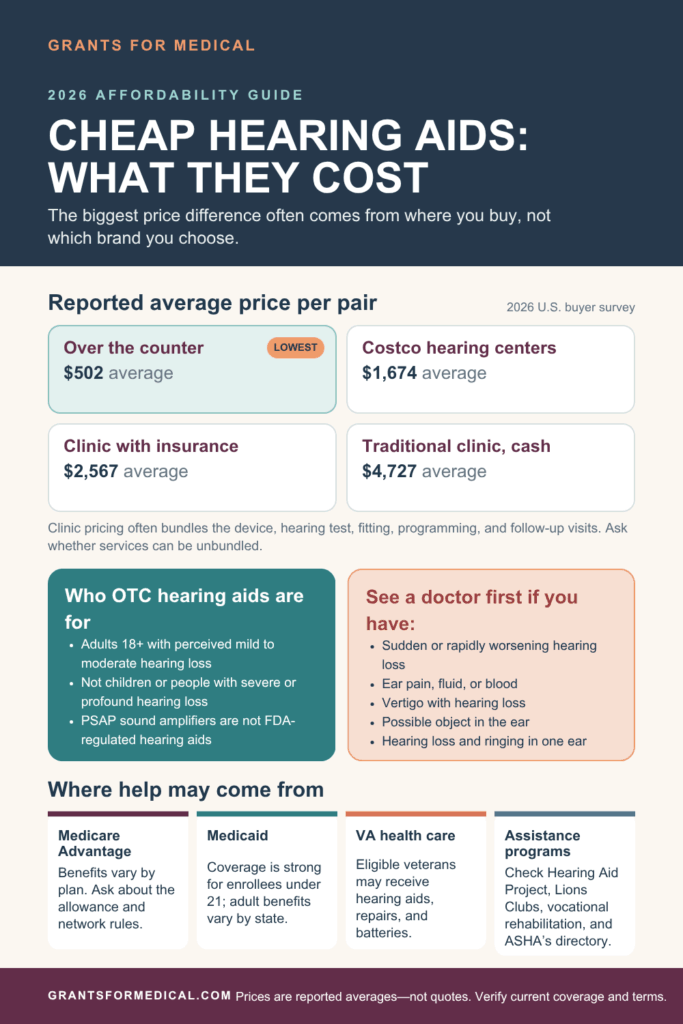
The single most useful fact about hearing aid pricing is that the price depends far more on where you buy than on which brand you buy. HearingTracker’s 2026 survey of more than 1,100 owners put the average at $2,694 a pair, down from $4,672 in 2018. Broken out by channel, the spread is enormous:
- Traditional clinic, paying cash: $4,727 average, $5,000 median
- Traditional clinic, with insurance: $2,567 average
- Costco hearing centers: $1,674 average
- Over the counter, bought online or in a store: $502 average, $200 median
The same survey found that traditional clinic prices have barely moved since 2018. The overall average fell because buyers moved to cheaper channels, not because clinics cut prices. If you only do one thing after reading this, price the same technology at a Costco hearing center before you sign anything at a private clinic.
A large part of a clinic price is not the device. It is the hearing test, the fitting, the programming, and the follow up visits, usually sold as one bundled package. Some clinics unbundle, charging separately for the devices and each visit. If you are healthy, patient, and unlikely to need many adjustments, unbundling can lower what you pay up front.
Over the counter hearing aids, and who they are for
The FDA finalized the over the counter hearing aid rule in August 2022, and it took effect on October 17, 2022. It created a legitimate category of FDA regulated hearing aids that adults can buy in a store or online with no medical exam, no prescription, and no fitting by an audiologist. This is the single biggest change in hearing aid affordability in decades, and it is the reason a working pair can now cost two hundred dollars instead of four thousand.
The limits matter as much as the freedom. According to the NIDCD, over the counter hearing aids are only for adults 18 and older with perceived mild to moderate hearing loss. They are not for children, and they are not for severe or profound loss, because they cannot amplify enough to help. You might be in the mild to moderate range if speech sounds muffled, you struggle in groups or on the phone, you ask people to repeat themselves, or you keep the TV louder than everyone else prefers.
See a doctor rather than buying anything if you have ear pain, fluid or blood from the ear in the last six months, sudden or rapidly worsening hearing loss, vertigo with hearing loss, a suspicion that something is stuck in your ear, or hearing loss and ringing in only one ear. Those are signs of conditions that need treatment, not amplification.
One more distinction that costs people money: personal sound amplification products, sold as PSAPs, are not hearing aids. They are aimed at people without hearing loss who want to boost specific sounds, and the FDA does not regulate them as medical devices. If a listing avoids the words “hearing aid,” that is usually why.
Cheap has a floor, and it is around $500
This is where most affordability advice goes wrong, so it is worth being blunt. The cheapest devices are frequently a waste of money.
In the same 2026 survey, buyers of budget over the counter devices under $400, with a median price of $110, reported 48 percent satisfaction. Only 42 percent found them helpful day to day. Compare that with buyers of a higher end over the counter option with telehealth support at a median of $1,695, who reported 71 percent satisfaction and 86 percent daily helpfulness. Across every other channel, including clinics, Costco, and the VA, satisfaction clustered around 77 to 82 percent.
Independent lab testing points the same direction. Devices under roughly $500 tended to have consistently poor sound quality, with performance improving sharply as prices approached about $1,000 and then leveling off. Below a certain point you are dealing with real hardware limits in the microphones, processing, and feedback control, and no amount of adjusting settings fixes that.
The practical takeaway is that the sweet spot is not the cheapest listing. A $600 to $1,200 over the counter pair, or a Costco fitting near $1,700, will serve most people far better than a $99 pair, and both are a fraction of a clinic price. Buying a $110 pair that you abandon is not saving money.
What insurance and public programs actually cover
Original Medicare
Original Medicare does not cover hearing aids or the exams to fit them. You pay the full cost. It does cover some diagnostic hearing care: you can see an audiologist once every 12 months without an order from your doctor, but only for non acute hearing conditions such as hearing loss that developed over years, and for diagnostic services tied to surgically implanted hearing devices.
Medicare Advantage
Medicare Advantage plans, also called Part C, may include hearing benefits that Original Medicare does not. Coverage varies a great deal by plan, and a “hearing benefit” can mean anything from a full allowance to a discount through a managed care network. Call the plan and ask for the dollar allowance, how often you can use it, and which providers are in network. It is sometimes cheaper to skip a restrictive hearing benefit and negotiate directly with a local clinic.
Medicaid
For children, coverage is strong. Under the Early and Periodic Screening, Diagnostic and Treatment benefit, state Medicaid programs must cover diagnosis and treatment for hearing defects, explicitly including hearing aids, for enrollees under 21.
For adults, it is optional. Audiology services are mandatory for children but optional for adults, so adult hearing aid coverage depends entirely on your state. Some states cover a pair on a replacement schedule, some cover nothing. Check your own state program before assuming either way, and see our guide on whether Medicaid covers hearing aids.
Veterans
The VA is the most generous source of hearing aids in the country, and it is badly underused. Veterans enrolled in VA health care, or service connected at 10 percent for any condition, or service connected at any percentage for hearing loss, tinnitus, or ear disease, can receive hearing aids, repairs, and future batteries at no charge for as long as they remain eligible. Audiology is one of the few VA services you can schedule directly, without a referral from primary care.
Private insurance and state mandates
Most private plans historically excluded hearing aids, but that is shifting, and a number of states now mandate some level of coverage, most commonly for children. Buyers in the survey who used insurance at a traditional clinic saved an average of about 32 percent on premium devices and 51 percent on mid range devices. Call the insurer before you shop, and ask specifically whether the benefit runs through a managed care network, because that sometimes prices worse than negotiating on your own.
Programs for people who cannot pay at all
If none of the above applies and the money is not there, these are the established routes:
- The Hearing Aid Project, run by Hearing Charities of America and Sertoma, collects donated hearing aids, refurbishes them, and provides them free to qualifying low income applicants through partnering audiologists. Apply at hearingcharities.org or call (816) 333-8300.
- Starkey Cares Neighbors In Need lets individuals obtain hearing aids for a $300 application fee. Details at starkey.com/starkeycares or (855) 686-2202. Confirm the current fee with Starkey directly, since the figure is self reported to the NIDCD directory.
- Lions Clubs run local hearing screening programs and provide and repair hearing aids for people in need. Availability is entirely local, so contact the club or the state Lions hearing foundation in your area.
- State vocational rehabilitation agencies may cover hearing aids when hearing loss affects your ability to work or keep a job. This is one of the largest and least known sources of funding for working age adults.
- ASHA’s funding directory lists local agencies and programs for audiology services and hearing aids state by state, and is the best single starting point for finding help near you.
For a wider view of funding aimed specifically at hearing loss, see our guide to grants for the hearing impaired.
Four ways to lower the price yourself
These apply whether or not you qualify for any program above.
Do not upgrade on a schedule. Improvements between generations are usually small. Having your current aids retested and reprogrammed as your hearing changes often delivers more benefit than new devices, at a fraction of the cost.
Buy a lower technology tier. Manufacturers sell the same model in several tiers. Low end devices averaged $2,150 a pair against $5,225 for top end. A well programmed mid or low tier device commonly outperforms a premium device that was fitted poorly.
Use pretax money. Hearing aids are an eligible expense for health savings accounts and flexible spending accounts, and they count toward the medical expense deduction if you itemize and clear the threshold. That is a straight discount equal to your tax rate.
Ask about financing and unbundling. Most clinics offer no interest or low interest patient financing, and some will separate device cost from service cost if you ask.
When cheap is the wrong answer
Buy through a professional, not off a shelf, if your hearing loss is severe or profound, if you are buying for someone under 18, if you have any of the medical red flags listed earlier, or if you have tried an over the counter device and it did not help. Untreated hearing loss is associated with isolation, depression, reduced mobility, falls, and dementia risk, and only about one in four adults who could benefit from hearing aids has ever used them. The goal is not to spend the least. It is to end up with something you actually wear.
If the underlying problem is medical bills more broadly, our guides on help with medical bills and getting care without insurance cover the assistance programs that apply across all types of care.