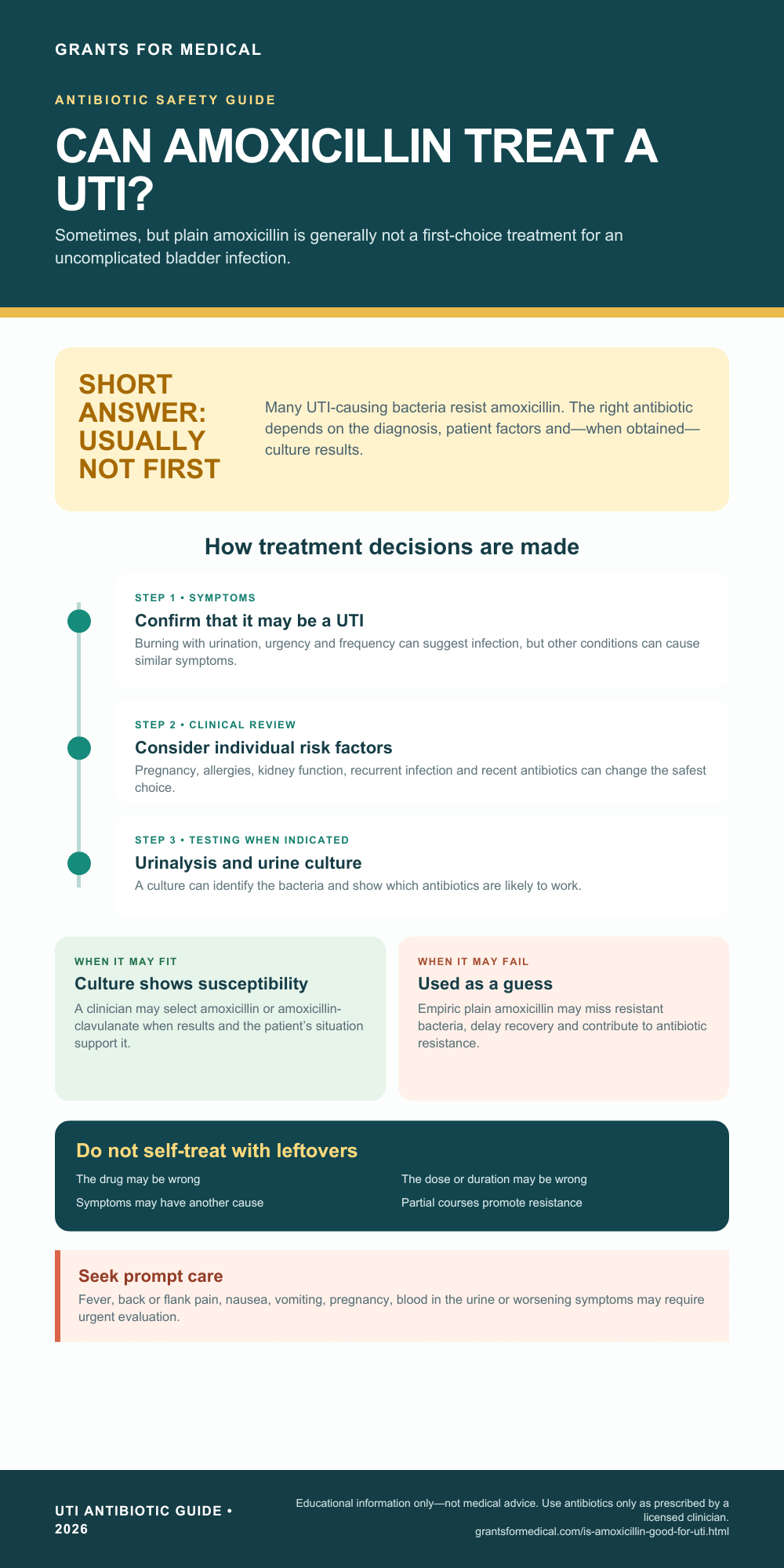
If you have a urinary tract infection (UTI) and a bottle of amoxicillin in the cabinet, it’s natural to wonder whether it will do the job. The short, honest answer is: usually not on its own. Amoxicillin is a common antibiotic, but for UTIs it has fallen out of favor because so many of the bacteria that cause them have become resistant. Here’s what the guidelines actually recommend, and where amoxicillin does and doesn’t fit.
Why Amoxicillin Isn’t First-Line for UTIs
Most uncomplicated UTIs, the common bladder infections, are caused by E. coli, which lives in the gut and accounts for the large majority of cases. Over decades of use, a high share of these E. coli strains have developed resistance to amoxicillin, meaning the drug often fails to clear the infection. For that reason, major guidelines from the Infectious Diseases Society of America (IDSA) do not list plain amoxicillin as a recommended first-line treatment for uncomplicated cystitis.
Taking an antibiotic the bacteria can resist doesn’t just risk treatment failure, it can prolong your symptoms, allow the infection to worsen (potentially reaching the kidneys), and contribute to broader antibiotic resistance. That’s why matching the right antibiotic to the infection matters so much.
What the Guidelines Recommend Instead
For a typical uncomplicated bladder infection, the commonly recommended first-line options are nitrofurantoin (often taken for five days), trimethoprim-sulfamethoxazole (a three-day course, but only where local resistance is low or the bacteria are known to be susceptible), and fosfomycin (a single dose). These are favored because they remain effective against most uropathogens and tend to cause less collateral resistance.
Which one is right depends on your health history, allergies, kidney function, whether you’re pregnant, and local resistance patterns, all reasons this is a decision for a clinician, not a guess from the medicine cabinet.
When Amoxicillin (or Amoxicillin-Clavulanate) Might Be Used
Amoxicillin isn’t useless for UTIs, it’s just not the empiric first choice. A doctor may prescribe it, or the combination drug amoxicillin-clavulanate (Augmentin), when a urine culture shows the specific bacteria are susceptible to it, or in particular situations such as certain pregnancies, where the safety profile of beta-lactam antibiotics is a consideration.
The key difference is that in those cases the choice is guided by testing or clinical judgment, not by assuming amoxicillin will work. A urine culture, when done, tells the clinician exactly which antibiotics will and won’t clear your specific infection.
Why You Shouldn’t Self-Treat a UTI
It’s tempting to reach for leftover antibiotics, but self-treating a UTI is risky. You might have resistant bacteria, the problem might not be a UTI at all (several conditions cause similar symptoms), and using the wrong or a partial course of antibiotics can drive resistance and delay real treatment. Leftover antibiotics are also rarely the right drug or dose.
See a clinician if you have UTI symptoms, burning with urination, urinary frequency or urgency, or pelvic discomfort. Seek care promptly if you develop fever, back or flank pain, nausea, or blood in the urine, which can signal a kidney infection that needs urgent treatment.
How a UTI Is Diagnosed
Getting the diagnosis right is what makes the treatment right. A clinician typically starts with your symptoms and a urinalysis, which checks a urine sample for signs of infection like bacteria and white blood cells. In many cases, recurrent infections, complicated cases, or when the first treatment fails, they’ll also order a urine culture, which grows the bacteria to identify exactly what’s causing the infection and which antibiotics will kill it.
That culture is precisely why guessing at home falls short: it can reveal that your infection is resistant to amoxicillin (or another drug) and susceptible to something else. When treatment is guided by testing, you’re far more likely to clear the infection on the first try.
Lowering Your Risk of UTIs
While you can’t prevent every UTI, a few habits help: stay well hydrated, don’t hold urine for long periods, and urinate after sex. For people with frequent, recurrent UTIs, a clinician can discuss evidence-based prevention strategies rather than repeated guesswork with antibiotics.
If you get UTIs often, it’s worth a fuller evaluation to understand why and to build a plan, which is far more effective than reaching for amoxicillin or any single antibiotic on your own.
Common Questions
Can amoxicillin treat a UTI? Sometimes, but it’s not the recommended first choice. Many UTI-causing bacteria are resistant to amoxicillin, so guidelines favor nitrofurantoin, trimethoprim-sulfamethoxazole, or fosfomycin. Amoxicillin is mainly used when a urine culture shows the bacteria are susceptible or in specific situations a doctor identifies.
What is the best antibiotic for a UTI? There’s no single ‘best’, it depends on your situation and local resistance. Common first-line options for an uncomplicated bladder infection are nitrofurantoin, trimethoprim-sulfamethoxazole (where resistance is low), and fosfomycin. A clinician chooses based on your history and, when needed, a urine culture.
Can I treat a UTI without seeing a doctor? It’s not advised. Symptoms can overlap with other conditions, the bacteria may be resistant, and the wrong antibiotic can worsen things and drive resistance. See a clinician for diagnosis and the right prescription, and seek prompt care for fever or back pain, which can signal a kidney infection.