Sonography is a smart career bet: the work is in demand across New York, the training is relatively short, and you don’t need a four-year degree to start. Below is a practical look at accredited programs in New York, how to get certified, and how to cover the cost.
Before you fall for any program’s marketing, check one thing, accreditation, because in New York, as everywhere, it’s what makes you eligible to certify and get hired. Getting this right saves you time, money, and a lot of frustration.
Where to Study Sonography in New York
Your shortlist in New York should start with CAAHEP-accredited programs, since that accreditation is the gateway to the ARDMS certification exams. Among the accredited choices are SUNY Downstate Health Sciences University in Brooklyn, Hudson Valley Community College, Long Island University, and Rochester Institute of Technology.
New York’s programs span the state, from SUNY Downstate in Brooklyn to Hudson Valley in the Capital Region and RIT in Rochester, covering both downstate and upstate applicants.
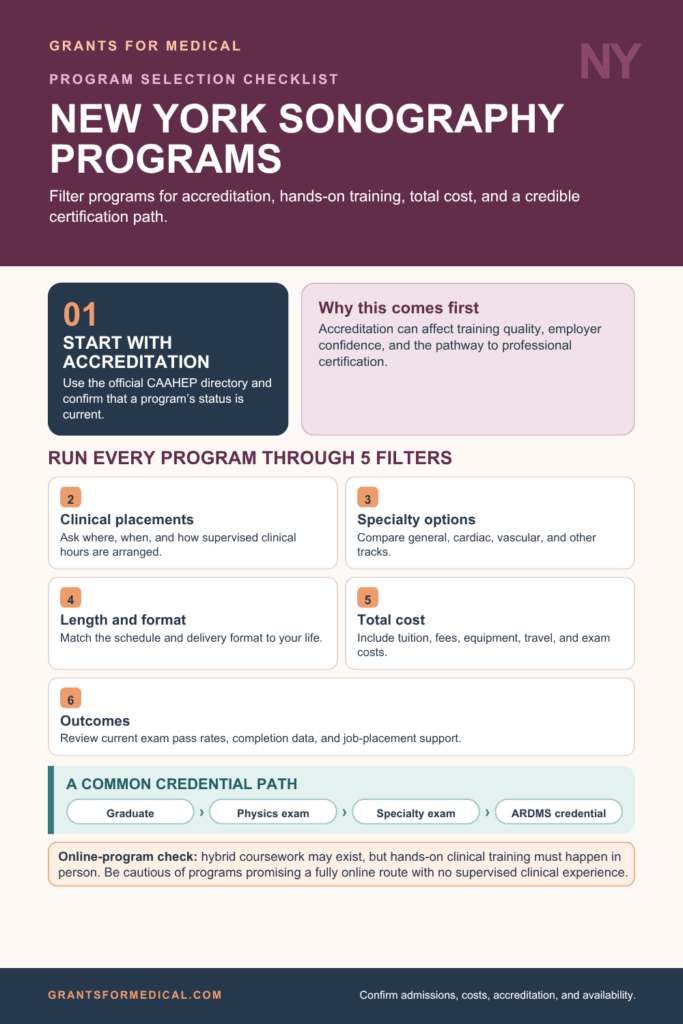
Treat that as a starting point rather than the final word: check each program’s current status in the official CAAHEP directory, and look closely at which sonography specialties it covers, because that determines which certifications and roles are open to you afterward.
How to Compare Your Options
Once you have a few accredited New York programs on your list, compare them on a handful of practical points. Clinical placement is the big one: ask where students do their rotations and whether the school guarantees a site, because hands-on scanning hours are what make you job-ready.
Also weigh the specialties offered, the length and format (full-time versus part-time), the true total cost including fees and equipment, and the program’s exam pass rates and job-placement history. A cheaper program with weak clinical sites can cost you more in the long run.
The Certification Path After You Graduate
After an accredited program, the next milestone is national certification, which is what hiring managers expect to see. ARDMS awards the RDMS credential once you pass its physics exam and a specialty exam, with separate tracks for cardiac and vascular sonographers.
Since most states don’t license the profession, certification effectively stands in for a license. Adding more specialty credentials down the road, say, in echocardiography or vascular technology, tends to widen your options and lift your earnings.
Is an Online Program Realistic?
You’ll see ‘online sonography’ advertised, but be careful. Because the job is hands-on, no reputable program is entirely online; the scanning hours have to happen in person. Some New York programs do run a hybrid model, delivering the classroom side online while you complete clinical rotations at a local facility.
Any program promising a fully online path with no supervised clinical time is one to avoid, it won’t prepare you for the ARDMS exams or for actual work.
Affording Your Training in New York
Because costs swing widely, focus on the all-in number rather than the headline tuition. In New York, community-college programs usually cost the least; university and hospital programs run higher but can bundle in strong clinical placement. Start every plan with the FAFSA, as accredited schools generally open the door to federal aid.
Then stack scholarships on top, the SDMS Foundation offers student awards, and societies and employers sometimes chip in more. Hospitals struggling to hire sonographers occasionally fund schooling in exchange for a commitment, so that’s a question worth asking directly.
Career Prospects in New York
Demand is a big reason people choose this field. Nationally, employment of sonographers is projected to grow much faster than the average for all occupations, driven by an aging population and the shift toward imaging that avoids radiation. New York shares in that demand, especially around its larger hospitals and clinics.
Pay is solid for a two-year credential, and it climbs with experience and added specialties. For current, specific wage and growth figures, check the U.S. Bureau of Labor Statistics, which publishes state-level data for diagnostic medical sonographers.
Common Questions
How long does it take to become a sonographer in New York? For most students it’s roughly two years through an accredited associate program in New York. Shorter certificates exist for people who already have a health-science background, and there are bachelor’s options too. Certification through ARDMS follows graduation.
Do I need a license to work as a sonographer? No. New York, like most states, has no separate sonographer license. What employers want is national certification, typically the ARDMS RDMS credential, which serves as the profession’s proof of competence.
Is choosing a CAAHEP-accredited program in New York really necessary? It’s strongly advisable. Graduating from a CAAHEP-accredited program is the most direct route to ARDMS exam eligibility, and employers expect it. Always confirm a program’s current accreditation status in CAAHEP’s official directory before enrolling.
Is an ultrasound tech the same as a sonographer? They’re often used interchangeably, and they refer to the same work. ‘Sonographer’ or ‘diagnostic medical sonographer’ is the formal title; ‘ultrasound tech’ is the everyday name for the same role operating ultrasound equipment to capture diagnostic images.
Admissions requirements, tuition, accreditation status, and program availability can change, so verify them directly with the school.