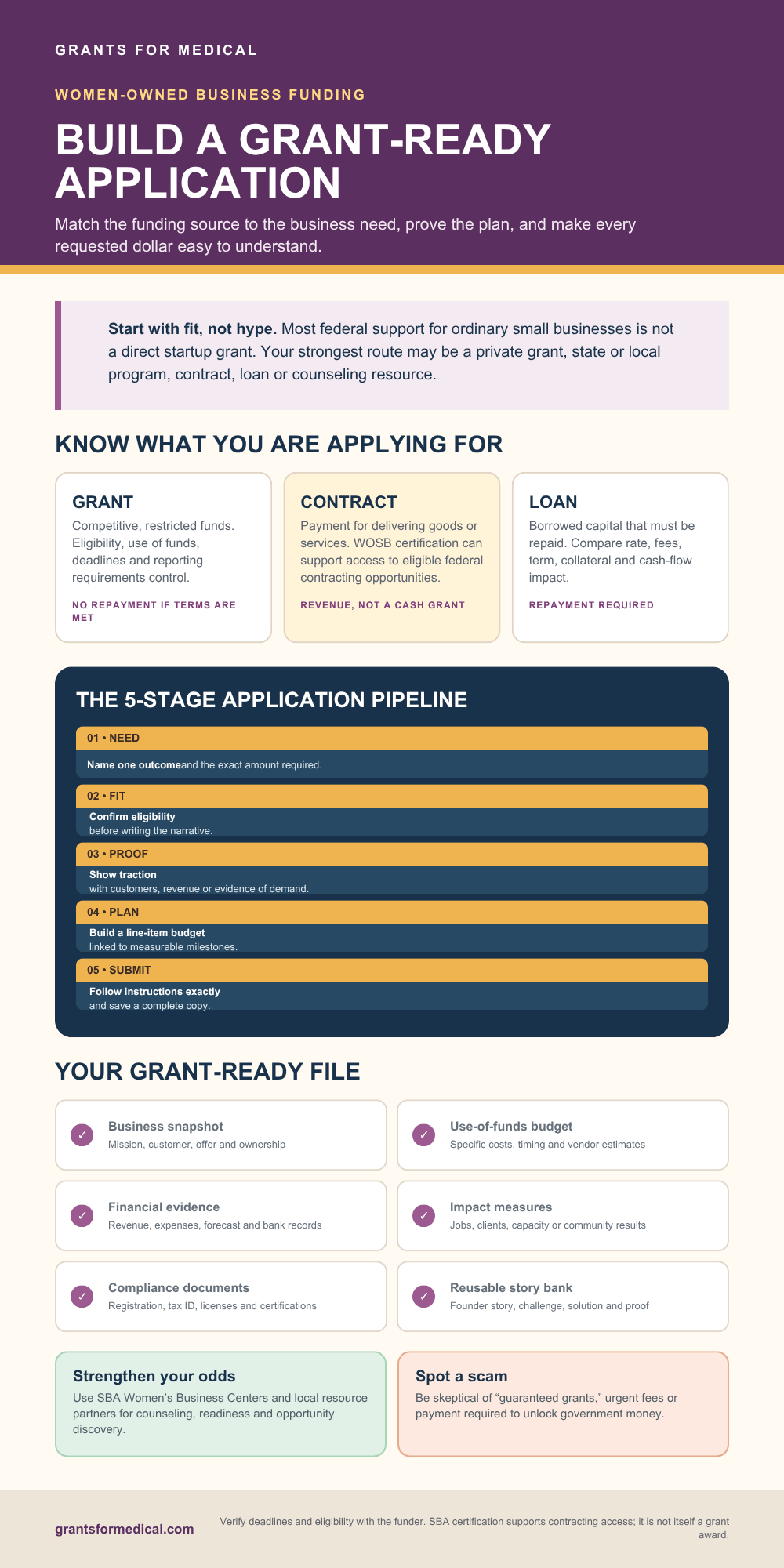
Grants for women-owned businesses are real, but they’re competitive and more specific than the ads suggest. Knowing the legitimate programs, and the free help that improves your odds, beats hours of searching that mostly turns up scams. This guide covers the grants worth your time, the free support behind them, and honest alternatives when a grant doesn’t come through.
We’ll start with established grant programs for women, then the free advisors who can help, and finally the financing that most businesses actually rely on.
Real Grant Programs for Women
A few well-known programs specifically fund women entrepreneurs. The Amber Grant awards multiple grants each month plus larger year-end awards, with a refreshingly simple application. IFundWomen runs a Universal Grant Application that matches you to corporate-sponsored grants from one form. The Tory Burch Foundation Fellowship combines an education grant with access to zero-interest loans and business training.
There are also periodic corporate and foundation contests aimed at women founders, and the Cartier Women’s Initiative for higher-growth ventures. Because deadlines and amounts change, confirm each program’s current cycle on its own website before applying.
Free Help That Improves Your Odds
You don’t have to navigate this alone, and the best help is free. The SBA funds Women’s Business Centers across the country that offer no-cost counseling, training, and help finding funding. SCORE provides free mentoring from experienced businesspeople, and your local Small Business Development Center advises on funding and applications at no charge.
These advisors know which grants are genuinely open and can strengthen your application, a far better use of time than paying a ‘grant finder’ service.
When a Grant Isn’t the Answer
Grants are worth pursuing, but they’re not most businesses’ main funding source. Financing often does what people hope a grant will. Look at SBA-backed loans, Community Development Financial Institutions (CDFIs) that lend to women and underserved founders on fair terms, and your state’s SSBCI-backed capital programs.
A quick safety note: never pay a fee to ‘apply’ for a grant, and treat any promise of ‘guaranteed free money’ as a scam. Legitimate grants come from established nonprofits, corporations, or government agencies, and free SBDC and SCORE advisors can help you tell the difference.
Other Places Grants Hide
The women-focused programs are a start, but don’t stop there. If your business does research or develops technology, the federal SBIR and STTR programs fund exactly that kind of work and were reauthorized in 2026. Many cities, counties, and states run their own small-business grant rounds, which draw smaller applicant pools than national contests. And industry associations and larger companies frequently sponsor pitch competitions and grants for founders in their field.
Local economic-development offices and your Small Business Development Center can point you to these hyper-local opportunities, which are often the most winnable precisely because fewer people know about them. It’s also worth setting up a free profile on a grant-matching platform like IFundWomen so relevant opportunities come to you instead of you hunting for each one.
Making Your Business Grant-Ready
Winning grants gets easier when your business is prepared. Have a clear, concise description of what you do and the difference funding would make, keep basic financials and any business registration current, and gather a reusable set of answers to the questions grant applications repeat. A short, genuine story about your business often carries more weight than jargon.
Applying to several programs each cycle, and reapplying when you don’t win, is normal, persistence and a polished application do more than chasing the single ‘perfect’ grant.
Certification That Opens Doors
If you sell to other businesses or the government, getting certified as a Women’s Business Enterprise (through the Women’s Business Enterprise National Council) or as a woman-owned small business with the SBA can open supplier and contracting opportunities set aside for women-owned firms. It isn’t a grant, but a steady contract can be worth far more than a one-time award.
Certification takes some paperwork, but your local Women’s Business Center or SBDC can walk you through it, and the same advisors can then help you find the buyers and programs that value the certification. For many women-owned firms, that pipeline of set-aside contracts ends up being a far more dependable source of revenue than chasing one grant at a time.
Common Questions
Are there real grants just for women-owned businesses? Yes, programs like the Amber Grant, IFundWomen’s grant network, and the Tory Burch Foundation Fellowship specifically fund women entrepreneurs. They’re competitive, so apply to several and confirm current deadlines on each program’s site.
Where’s the best free help to find funding? The SBA’s Women’s Business Centers, SCORE mentors, and your local Small Business Development Center all offer free advising on grants and financing, and they know which programs are actually open right now.
How do I avoid grant scams? Never pay to apply for a grant, don’t trust ‘guaranteed’ free money, and don’t give bank details to unsolicited callers. Real programs run through known nonprofits, companies, or government agencies.
Legitimate government grant programs do not guarantee an award or charge a fee simply to submit an application.