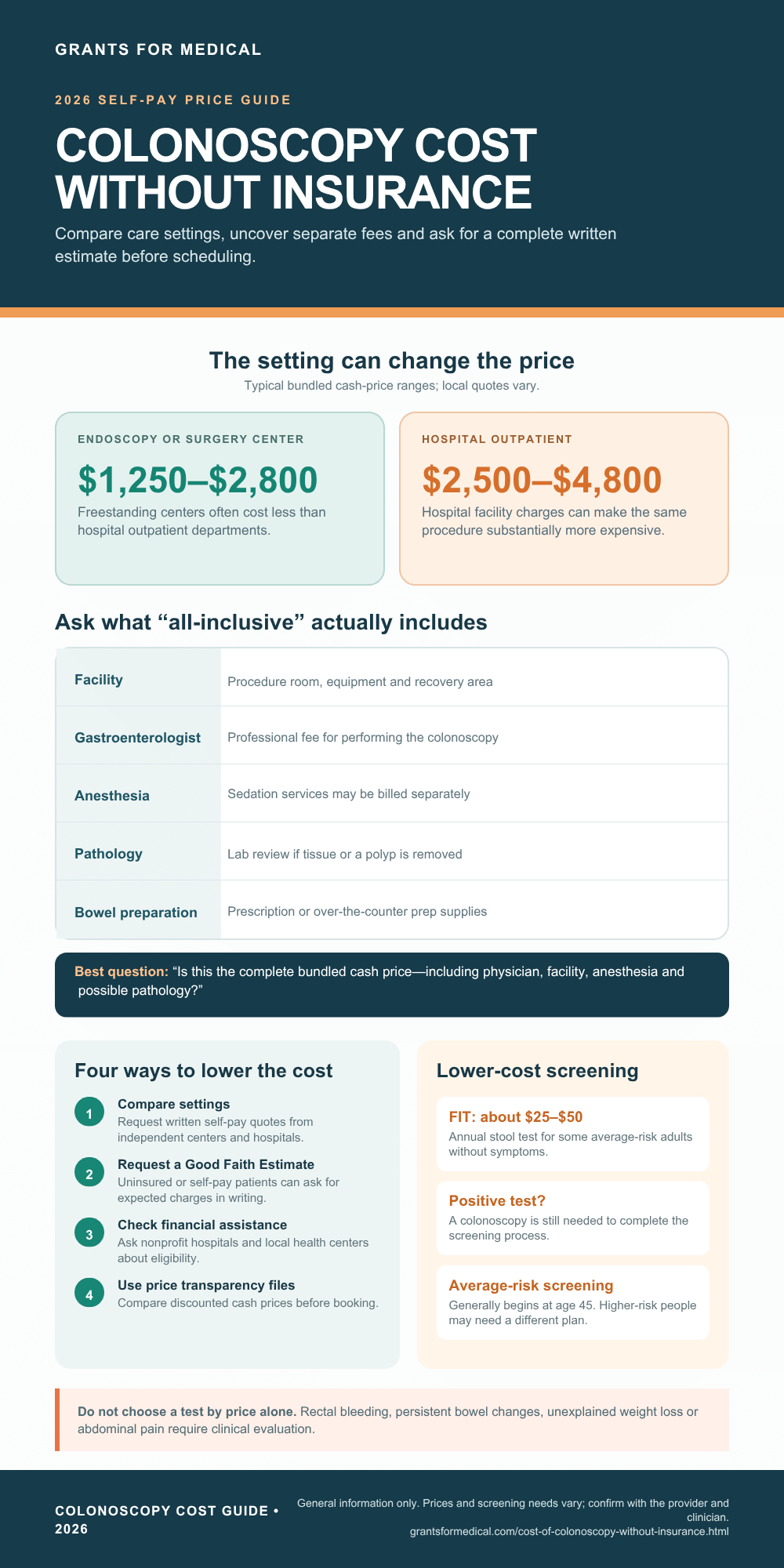
A colonoscopy without insurance typically runs $1,250 to $2,800 at an ambulatory surgery or endoscopy center and $2,500 to $4,800 at a hospital outpatient department. If that is out of reach, there is a legitimate cheaper first step: an at-home stool test costs $25 to $50 and is an accepted screening method for average-risk adults. The catch is important, so it is worth stating early. A positive stool test is not a result, it is an instruction to get a colonoscopy. Here is what each option costs, when screening should start, and where to find help paying.
What a Colonoscopy Costs Without Insurance
No federal source publishes national self-pay colonoscopy prices, so the ranges below come from commercial price trackers and self-pay networks. Treat them as a working range.
| Where it is done | Typical bundled cash price |
|---|---|
| Ambulatory surgery or endoscopy center | $1,250 to $2,800 |
| Hospital outpatient department | $2,500 to $4,800 |
The setting is the single biggest cost variable. Freestanding endoscopy centers are consistently cheaper than hospitals for the same procedure, and some national self-pay networks advertise all-inclusive packages starting around $1,275.
The word “all-inclusive” matters, because a colonoscopy generates several bills. Ask specifically whether your quote covers all of these:
The facility fee, the gastroenterologist’s professional fee, anesthesia or sedation, pathology if a polyp is removed and sent to a lab (roughly $100 to $500 per specimen), and the bowel prep kit (about $20 to $150). A quote that covers only the facility can double once the other bills arrive.
Cheaper Screening Options
For an average-risk adult with no symptoms, colonoscopy is not the only accepted screening method.
| Test | Self-pay cost | How often |
|---|---|---|
| FIT (fecal immunochemical test) | $25 to $50 | Every year |
| gFOBT | Under $25 | Every year |
| Multi-target stool DNA (Cologuard) | About $599 list, roughly $500 to $900 | Every 3 years |
| Colonoscopy | $1,250 to $4,800 | Every 10 years if normal |
Here is the part that gets glossed over. Stool tests screen, they do not diagnose. If a stool test comes back positive, you need a colonoscopy to complete the screening. That follow-up is often billed as a diagnostic procedure rather than a preventive one, which can mean a higher out-of-pocket cost. Stool testing lowers your upfront cost and is far better than skipping screening entirely, but it does not remove the possibility of needing a colonoscopy.
If you have symptoms such as rectal bleeding, a change in bowel habits, unexplained weight loss, or abdominal pain, stool testing is not the right path. Those need evaluation by a clinician.
When Screening Should Start
The US Preventive Services Task Force recommends colorectal cancer screening for average-risk adults beginning at age 45 and continuing through 75. The American Cancer Society’s 2026 guideline update reaffirms the same starting age of 45, continuing to 75 for people with a life expectancy over 10 years. Between 76 and 85, screening becomes an individual decision with your doctor.
Screening should start earlier and happen more often if you have a family history of colorectal cancer or advanced polyps, inflammatory bowel disease such as Crohn’s or ulcerative colitis, Lynch syndrome, familial adenomatous polyposis, or prior abdominal radiation. If any of those apply, talk to a clinician about a plan. Self-pay stool testing is generally not an adequate substitute in higher-risk situations.
Free and Low-Cost Screening Programs
One correction worth making, because many websites still get this wrong. The CDC Colorectal Cancer Control Program today funds clinics and health systems to improve screening rates rather than primarily paying for individual screenings the way it did years ago. It is still worth contacting your state’s program recipient to ask what direct help exists locally, but do not assume it hands out free colonoscopies.
What reliably helps:
Some state programs still fund tests directly for uninsured residents. Contact your state health department and ask about colorectal cancer screening assistance.
Federally qualified health centers use an income-based sliding fee scale and can order stool tests and arrange referrals. Find one at findahealthcenter.hrsa.gov.
Hospital financial assistance. Nonprofit hospitals are federally required to maintain a written financial assistance policy. Ask about it before scheduling, since approval can cut or eliminate the bill rather than leaving you to negotiate afterward.
How to Lower the Price
Ask for the bundled cash or self-pay rate, and confirm in writing that it includes facility, physician, anesthesia, and pathology. Ambiguity here is where surprise bills come from.
Use the CMS Hospital Price Transparency rule. Hospitals must publish discounted cash prices in a machine-readable file, so you can compare facilities before booking. Search the hospital name plus “price transparency.”
Request a Good Faith Estimate. If you are uninsured or self-paying, providers must give you a written estimate of expected charges when you schedule at least three business days out, or whenever you ask. If the final bill exceeds it by $400 or more, you can dispute it through the federal patient-provider dispute resolution process.
Colonoscopy Cost Without Insurance FAQs
How much does a colonoscopy cost without insurance?
Roughly $1,250 to $2,800 at an ambulatory surgery or endoscopy center and $2,500 to $4,800 at a hospital. Confirm whether the quote includes facility, physician, anesthesia, and pathology fees.
Is there a cheaper alternative to a colonoscopy?
Yes, for average-risk adults without symptoms. A FIT test costs $25 to $50 annually and multi-target stool DNA testing runs about $599 every three years. A positive result still requires a follow-up colonoscopy.
At what age should I start colorectal cancer screening?
Age 45 for people at average risk, according to both the USPSTF and the American Cancer Society, continuing through age 75. Start earlier if you have a family history, inflammatory bowel disease, or a genetic syndrome.
Does the CDC provide free colonoscopies?
Generally no. The CDC’s Colorectal Cancer Control Program now funds clinics and health systems to raise screening rates rather than paying for individual screenings. Some state programs do fund tests directly, so contact your state health department.
Why did I get several bills for one colonoscopy?
The facility, the gastroenterologist, anesthesia, and pathology are commonly billed separately. Ask for a bundled all-inclusive cash price in writing to avoid this.
What if I cannot afford the procedure at all?
Ask the hospital about its financial assistance policy before scheduling, since nonprofit hospitals are required to have one. A federally qualified health center can also order lower-cost stool testing on a sliding fee scale.
Actual out-of-pocket cost varies by location, provider, insurance terms, financing charges, and the services ultimately required.